
We are almost starting a new black truffle season in Europe, although it is not going to be a good one.
Summer was pretty hot and not a single drop of rain from early May until end of September, so we expect almost no wild truffles (this is why Tuber magnatum is expensive this season too), and plantations with no irrigation (still over 70-80% in Spain) won´t have any good productions. Even irrigating, if their is no rain at all, crops are not the same because trees won´t produce much sugars to feed our truffles.
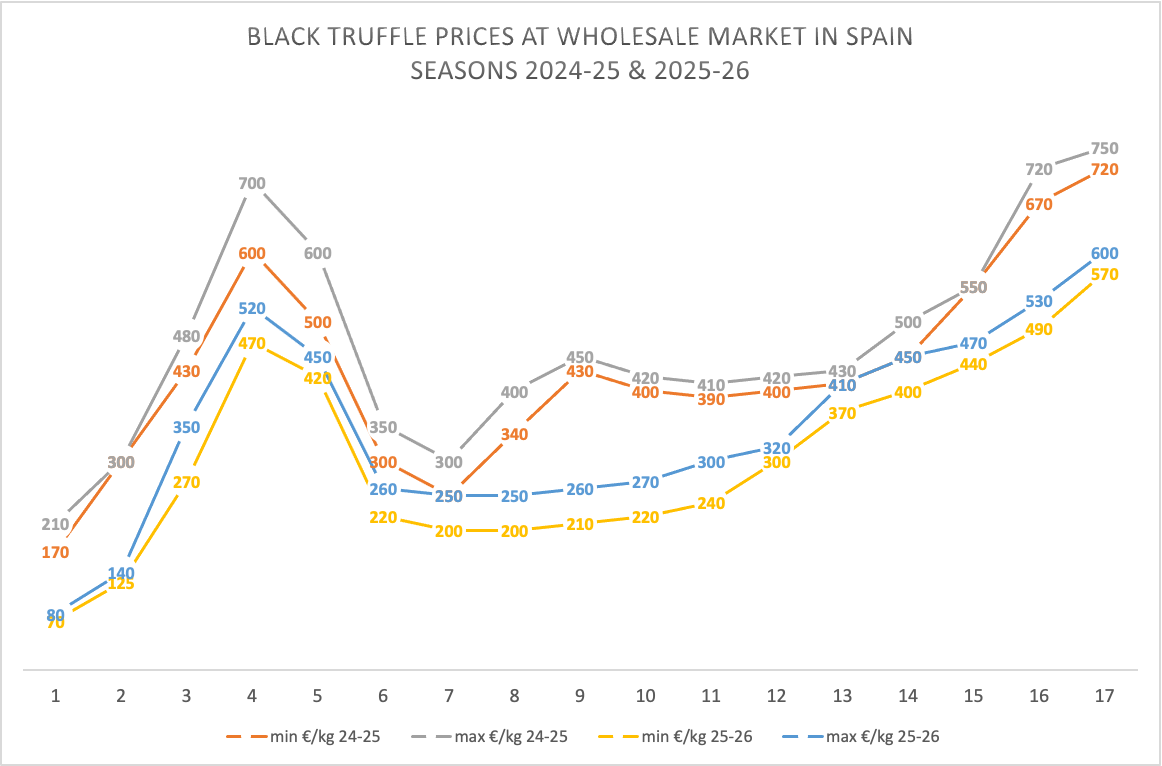
Last year though, 2025-2026 was a pretty good season for Tuber melanosporum, with probably 150 tonnes produced in the whole Spain, so prices dropped to quite a lot. The lowest I´ve ever seen, that may have dragged the southern hemisphere markets with it. As reflected in the figure above with minimum and maximum prices paid at whole sale market, (dirty truffles, all qualities mixed). I added market prices for the previous season 2024-25 to be able to compare.
TRUFFLE FARMING IN THE SOUTHERN HEMISPHERE
TRUFFLE FARMING IN CHILE FOR 2026
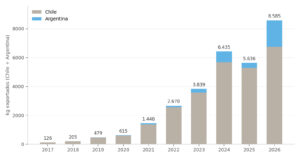
Between May and August, Chile exported 6,750 kg, generating 3.04 million USD—a 30% increase over 2025, though the average price was 5% lower. Six companies account for the bulk of these exports; Mundo Chile is the leading exporting to eight markets across three continents (three in Europe, one in the Americas, and four in Asia and the Middle East), followed by Global Truffles and Katankura. By market, the breakdown is as follows: Spain 33%, the United States 21%, France 20%, Italy 10%, Asia (Hong Kong, Japan, Taiwan, and the UAE) 8%, with the remaining 8% distributed among Canada, Switzerland, the United Kingdom, and Germany.
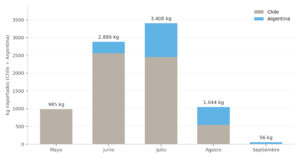
The Chilean season begins in May, peaking during the second half of June. Prices reached their lowest point in July, while August saw a recovery in value alongside a volume of half the previous month’s total. The average monthly price for Chilean exports ranged between 370 and 610 USD/kg, with peak values reaching as high as 1,200 USD/kg.
This year in mid-July, the season was affected by an «atmospheric river» that brought continuous rainfall and impacted most operations.
you can follow Chilean truffle industry on their annual review: https://www.atchile.cl/revista/
you can download the last number for 2026 here
TRUFFLE FARMING IN ARGENTINA FOR 2026
ARGENTINA: 3 TONS, TWO EXPORTERS, AND AN ASSOCIATION UNDERWAY
The 2026 season marked a significant scaling up. Argentine production of Tuber melanosporum is estimated at approximately 3 net tons (3.5 tons of gross harvest, including soil). The harvest runs from June to mid-September, with peak maturity occurring in July—three to four weeks later than in Chile. Of this total, between 250 and 300 kg were allocated to the domestic market, while about 1,850 kg were exported through two companies—triple the volume recorded in 2025. Trufas del Nuevo Mundo, based in Espartillar, Buenos Aires Province, is the largest Argentine producer and exporter; it manages 50 hectares of plantations, accounts for nearly 80% of the export volume, and reaches the widest range of destinations, including the United States, France, the United Kingdom, Brazil, Mexico, Central America, and Asia.
Export destinations, by volume: France 53%, United States 45%, and Brazil, the United Kingdom, and others 2%.
FOB prices followed the trend seen across South America, reaching a low in July and a peak in September; the average monthly price for Argentine truffles ranged from 310 to 850 USD/kg, with the highest values reaching 1,000 USD/kg.
The total planted area now spans approximately 450 hectares, primarily in the province of Buenos Aires—specifically in the southwestern hilly region (the districts of Adolfo Alsina, Saavedra, Tornquist, Coronel Suárez, Puan, Bahía Blanca, and Guaminí) and the southeastern part of the province (Azul, Balcarce, Necochea, and Mar del Plata)—with additional new plantations in Córdoba and Patagonia. A significant portion of this area has yet to reach the production stage, pointing to an expected increase in volume over the coming years.
TRUFAR, THE ARGENTINE ASSOCIATION OF TRUFFLE GROWERS, AND TRUFFLE CULTIVATION SYMPOSIA: THE SECTOR GROWS AS A WHOLE
On an institutional level, the sector took three major steps this year:
a) The formal process to establish the Argentine Association of Truffle Growers.
b) The fifth edition of «Trufar»—the Argentine Black Truffle Festival—held on June 13–14 in Espartillar (in the Saavedra-Pigüé district), was officially recognized as being of legislative interest by the Chamber of Deputies of the Province of Buenos Aires (https://trufar.com.ar).
c) On October, Bariloche is just hosting the Second Patagonian Conference and the First Argentine Conference on Truffle Cultivation—organized by the Government of Río Negro and CIEFAP, with funding from the CFI—at the Bariloche Electricity Cooperative auditorium. The event is aimed at producers, consultants, researchers, nursery operators, and chefs (https://jornadasdetruficultura.rionegro.gov.ar).
ARGENTINE TRUFFLE SCIENCE: THREE KEY STUDIES
Truffle cultivation in Argentina now has its own scientific foundation, documented in international journals. Regarding soil and climate suitability, the CIEFAP-CONICET team published a suitability map for Tuber melanosporum in Argentine Patagonia in *Forest Systems* (2025). This study identifies over 1.3 million hectares—representing 3% of the Patagonian landmass—as suitable for cultivation. (https://fs.revistas.csic.es/index.php/fs/article/view/21006).
This same team also released a manual this year titled *Truffle Cultivation in Argentine Patagonia: A Step-by-Step Guide (CIEFAP, https://ciefap.org.ar).
Regarding product quality, Eva Tejedor-Calvo (CITA Aragón) and the research group led by Eduardo Nouhra (IMBIV, CONICET-UNC) characterized the aromatic profile of 102 Argentine black truffles in *Food Research International* (2023). (https://doi.org/10.1016/j.foodres.2023.113300).
Regarding the post-harvest stage, Stella Maris Romero and colleagues (IMBIV-CONICET, in collaboration with Italy’s CNR) published the first study on the microbiota of Argentine truffles during storage—under both domestic and industrial refrigeration—in the *International Journal of Food Microbiology* (2026). Based on samples from a truffle farm in the province of Buenos Aires, this research provides a foundation for establishing preservation protocols and determining shelf life for export purposes (https://doi.org/10.1016/j.ijfoodmicro.2025.111546).
TRUFFLE FARMING IN AUSTRALIA FOR 2026
The single largest crashing of price whilst also less global production. The average price in the Southern Hemisphere dropped probably for 2 reasons: Quality (average size) but mostly due to immature market practices. Whilst some markets have displayed recession type symptoms, others are really strong, so not convinced on market confidence as a major impact on prices. Overall that equated to a smaller harvest size than 2025. The market was unable to reconcile the smaller market through competitive pricing. It is a concerning trend for the future of the industry globally.
Australia in 2026 shrunk in production, 2025 WA alone was around 24t, and estimated production of 16t WA and 2t east coast regions.
The season in Victoria and NSW starts 3–4 weeks later than in Western Australia, truffles are not ripe before July on the East, what becomes a shorter season. Same patter happen in South America as you´ll see on the figures.
The volume of truffles reaching the domestic market is higher than the demand, which makes it increasingly difficult for growers to sell their truffles at a good price if not exporting.
TRUFFLE FARMING IN NEW ZEALAND FOR 2026
Here an article that will give you a snapshot of the industry (page 60)
https://issuu.com/hortnz/docs/nzgrower_orchardist_august_2026
Re exports there were only 2 export licence exemptions granted for 100kg total. But only a small sample of truffle actually got shipped. Logistics from NZ and reliable courier/freight scarce are scarce. The NZ Truffle Association has focused on lifting the profile of truffles in NZ with branding and a national truffle day.
The prices an competition were difficult this season. The economy, Tourism and high end hospitality also started to drop war started in Iran.
The NZTA has just had its AGM, intending to push export development to cope with envisioned inches in truffle production.
TRUFFLE FARMING IN SOUTH AFRICA
The South African truffle industry is fairly fragmented. There is no truffle growers’ association or central body to collate data, and no support from government. So hard to get data, number of orchards planted, country production, etc.
Published estimates have put the national figure at roughly 100 ha, although what percentage of these orchards can be deemed successful is unknown. Some of the more promising results appear to be coming from the high-altitude Southern Drakensberg region of KwaZulu-Natal, while the Western Cape, which probably has the most orchards by number, has yet to realise its potential. Because of the challenges experienced by the early adopters and very few outright successes, it would appear that the rate of new investment in the industry has declined over the last few years.
South Africa came relatively late to truffle growing, with the first commercial orchards being planted around 2010. Many of the country’s orchards were only planted later in the decade, so they are only now reaching maturity. There are orchards spread across the Western Cape in the south of the country, the high-altitude Southern Drakensberg region of KwaZulu-Natal on the east coast, and a few in Mpumalanga province in the north. There is no doubt that the industry has had its challenges, with a lot of the early plantings not living up to yield expectations.
Yields appear to vary a great deal from orchard to orchard and region to region. A few orchards are producing small yields, but many of the early plantings appear to be underperforming. Whether this is due to management or environment is difficult to know. As the younger plantings mature over the coming seasons and truffle farming techniques are adapted to African conditions, I am hopeful that the national yield will improve.
It is also very difficult to determine the total national yield, but I would hazard a guess that it is a few hundred kg at most, coming mainly from a small handful of orchards. It is most likely consumed locally, with only one or two orchards possibly achieving export quantities.
I would like to thank Javier Rozas, Faustino Terradas, Ben Sheridan, Gavin Booth, George Wilkinson, David Whalley and Max Bastard for their feedback in order to get all these figures.
Marcos Morcillo





Deja tu comentario